Leaf Activities for Kids: 20 Things to Do With Fall Leaves
Fall leaves are one of the easiest free play materials autumn gives you.
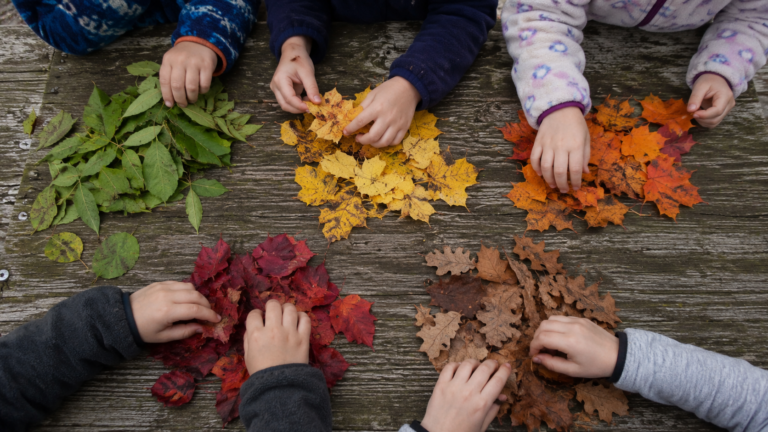
A handful of leaves can become art supplies, sorting materials, sensory play, a science activity or simply an excuse to get outside. You do not need a complicated setup, expensive craft materials or a perfectly planned afternoon.
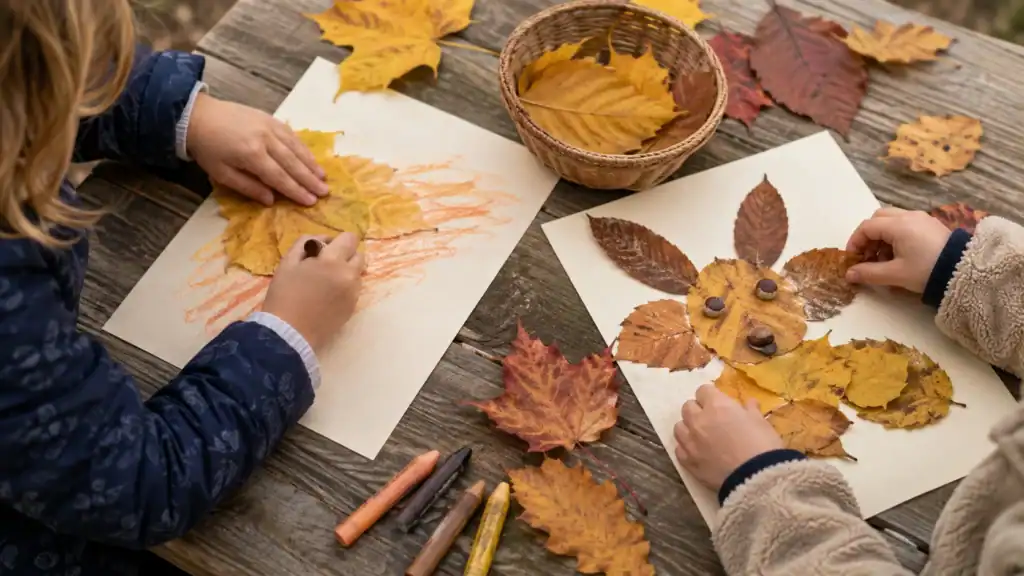
These 20 leaf activities for kids include quick outdoor ideas, simple leaf crafts, sensory activities and easy ways to notice the changing season.
Outdoor play gives children opportunities for movement, exploration and open-ended play, and the American Academy of Pediatrics specifically encourages families to make nature and outdoor time part of everyday childhood.
Quick Start
Choose three leaf activities:
One quick thing + one outdoor activity + one project worth keeping.
That gives you something easy for today, something for a longer autumn afternoon and one activity that might even become part of your family’s fall traditions.
Pick three leaf ideas: one quick thing, one outdoor adventure and one project worth keeping.
Save the rest for those fall afternoons when nobody knows what to do.
20 Leaf Activities for Kids
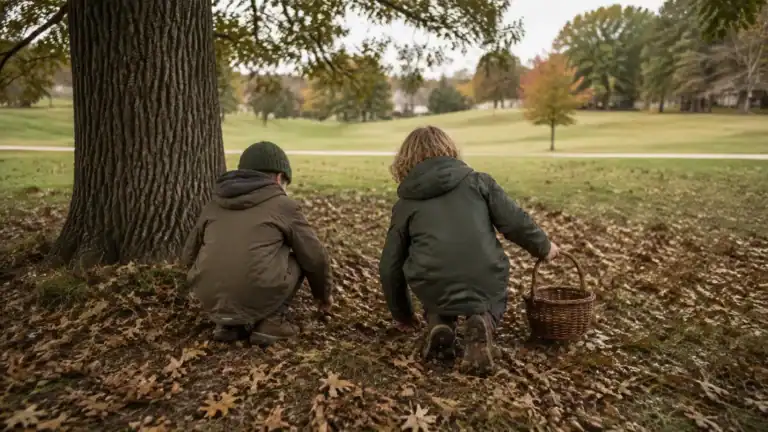
1. Go on a fall leaf hunt
Take a basket, bucket or paper bag outside and see what you can find.
You could look for:
- A bright yellow leaf
- A tiny leaf
- A giant leaf
- A red leaf
- A leaf with spots
- A leaf with jagged edges
- A crunchy leaf
- A leaf with several colors
There is no need to turn it into a formal scavenger hunt. For younger children, collecting whatever catches their attention is enough. If a list helps, try this fall scavenger hunt with leaf and color prompts.
If your kids enjoy collecting natural treasures, try these 17 easy nature activities for kids for even more simple outdoor ideas.
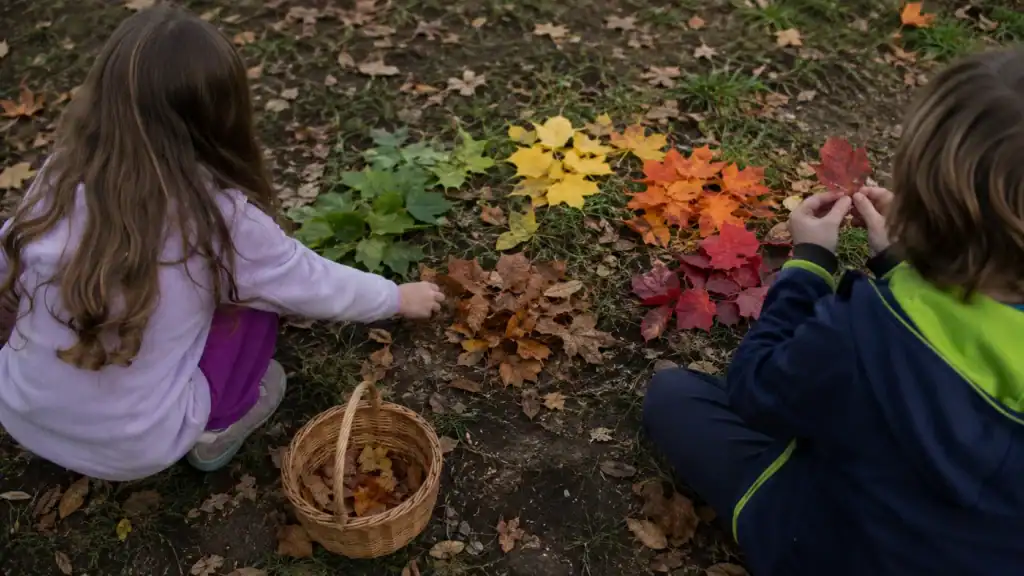
2. Sort leaves by color
Tip the leaves onto the ground or a table and make groups.
Try:
green → yellow → orange → red → brown
Toddlers can simply match similar colors. Older children can arrange shades from lightest to darkest or look for leaves that contain more than one color.
This is also an easy moment to talk about why leaves change color. As days become shorter, chlorophyll in deciduous leaves breaks down. Yellow and orange pigments that were already present become more visible, while some trees also produce red pigments called anthocyanins
3. Make leaf rubbings
Put a leaf vein-side up underneath a sheet of paper.
Remove the wrapper from a crayon and rub the side of the crayon gently over the paper.
Slowly, the leaf shape and veins appear.
Try using several different leaves on one page so kids can compare their shapes and vein patterns.
4. Make a leaf crown
Cut a strip of sturdy paper that fits comfortably around your child’s head.
Attach fallen leaves with tape or child-safe glue, then join the ends together.
The collecting can be half the activity: let kids choose the leaves for their own crown during a short walk.
5. Create leaf animals
Different leaf shapes already look a little like ears, wings, tails and bodies.
Arrange them into:
- Foxes
- Owls
- Fish
- Hedgehogs
- Butterflies
- Birds
- Completely imaginary creatures
Add little sticks, acorn caps or drawn details if you want.
The Best Ideas for Kids has a fun collection of leaf animal craft ideas if you want some visual inspiration.
6. Jump in a leaf pile
Sometimes the most obvious idea is still one of the best.
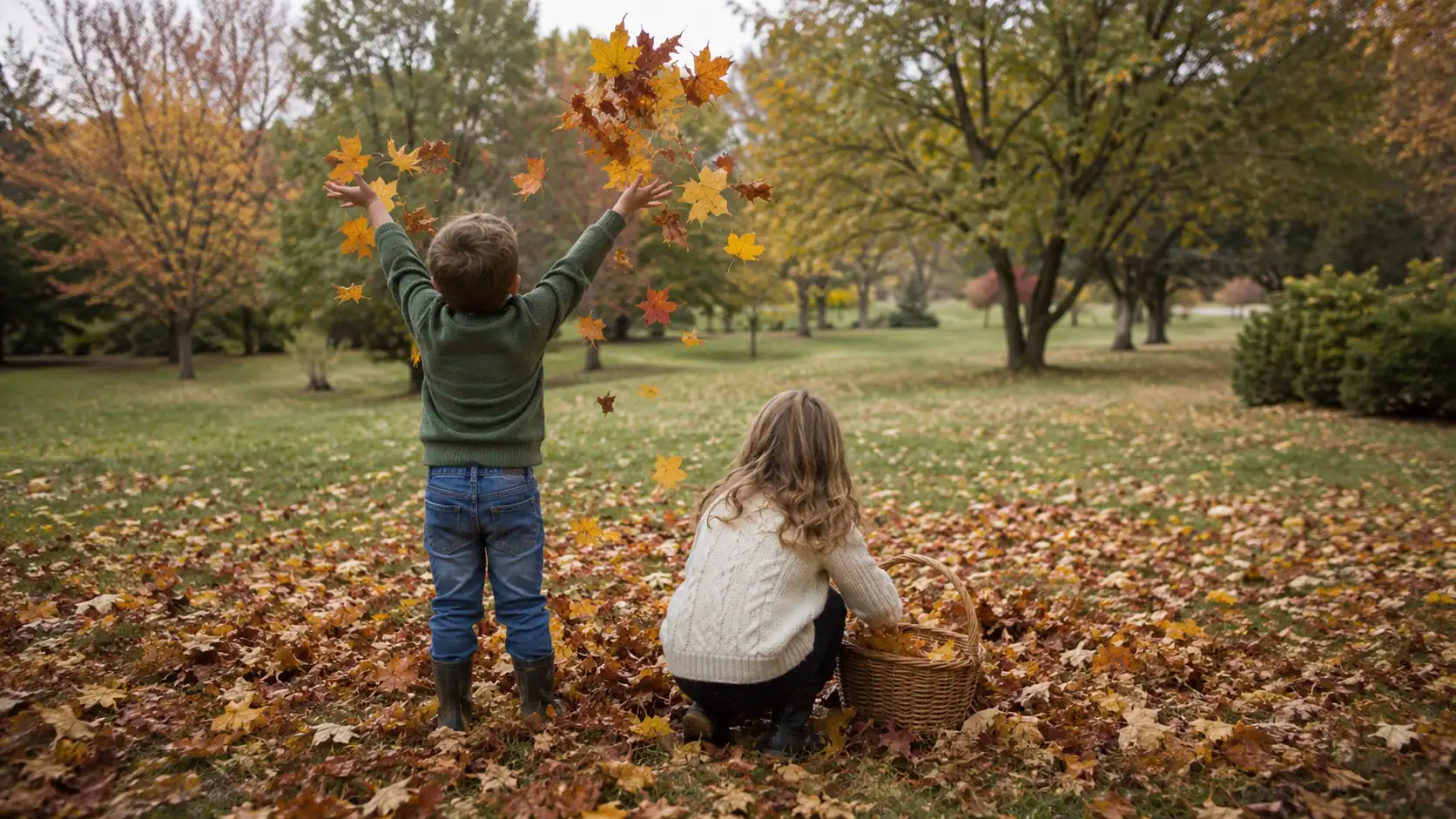
Rake dry leaves into a loose pile in a safe part of the yard and let the kids jump, kick and toss.
Check the pile first for sharp sticks, stones, animal waste or anything else hidden underneath.
Avoid creating piles near roads or driveways.
For more seasonal outdoor fun, explore these fall outdoor activities for kids that make the most of cooler days, leaves and changing weather.
7. Make a leaf rainbow
Collect leaves in as many shades as possible and arrange them into a color gradient.
Try:
green → lime → yellow → ochre → orange → rust → red → brown
It does not need to be perfect.
Photograph the finished rainbow before the wind decides to redesign it.
8. Press your favorite leaves
Choose leaves that are reasonably flat and dry.
Place them between sheets of plain paper inside a heavy book.
Add another heavy book on top and leave them for several days.
Pressed leaves can later be used for:
- Cards
- Collages
- Nature journals
- Garlands
- Bookmarks
Nature Inspired Learning also has useful fall-leaf activities built around observing, tracing and identifying leaves.
9. Make a leaf collage
Give kids a piece of thick paper or cardboard and a pile of leaves.
They can turn them into:
- A tree
- A landscape
- An animal
- A face
- A pattern
- Something completely abstract
There is no correct result.
The process of choosing, moving, layering and changing the arrangement is part of the activity.
10. Make silly leaf faces
Choose several larger leaves.
Add simple eyes, mouths, eyebrows or hair using paper scraps or washable markers.
Give each leaf a name.
Older kids can invent a short story about the characters.
Turn It Into a Fall Challenge
Already collecting leaves?
You can turn these activities into part of a bigger seasonal challenge.
The Autumn Bucket List Printable gives kids 16 simple seasonal adventures to check off throughout autumn, including easy ideas you can do close to home.
Get the Autumn Bucket List Printable on Etsy
Autumn Bucket List Printable
Prefer one simple sheet on the fridge? This printable gives kids 16 seasonal activities to check off as fall goes on.
Get the fall bucket list →11. Trace leaf shapes
Put a leaf on a sheet of paper and trace carefully around the edge.
Compare different leaves.
Look at:
- Pointed versus rounded edges
- Wide versus narrow leaves
- Lobes
- Veins
- Stem length
- Symmetry
This works especially well as part of a simple nature journal.
12. Make leaf prints with paint
Paint a thin layer of washable paint onto the veined side of a leaf.
Press the leaf onto paper and smooth it gently.
Lift it away to reveal the print.
Try several leaves on the same sheet or overlap different colors.
13. Find the crunchiest leaf
Collect a few leaves in different stages of drying.
Choose:
- A fresh flexible leaf
- A slightly dry leaf
- A brown leaf
- A very crispy leaf
Then compare them.
Which bends?
Which tears?
Which makes the loudest crunch?
It is a tiny sensory experiment requiring almost no preparation.
If your child loves touching, listening and experimenting with natural materials, these 25 free fall sensory activities for kids are a great next step.
14. Make a nature bracelet
Wrap a piece of wide masking tape loosely around your child’s wrist with the sticky side facing outward.
During a walk, add tiny loose natural finds such as fallen leaf pieces or grass.
Only collect things that have already fallen rather than pulling living plants apart.
15. Make natural leaf confetti
Older children can use a hole punch to punch tiny circles from colorful leaves.
Use the pieces for:
- Collages
- Cards
- Nature art
- Table decorations
Keep it genuinely natural if you plan to compost it afterward.
Avoid mixing it with glitter or plastic confetti.
Collect something + notice something + make or do something.
That is enough to turn an ordinary fall walk into sensory play, simple nature study and a low-prep activity.
16. Compare leaf veins
Choose two or three leaves and hold them up to the light.
Follow the large central vein, then notice how smaller veins branch away from it.
Try using a magnifying glass.
Ask:
Do all the leaves have the same pattern?
Which has the thickest veins?
Which has the most branches?
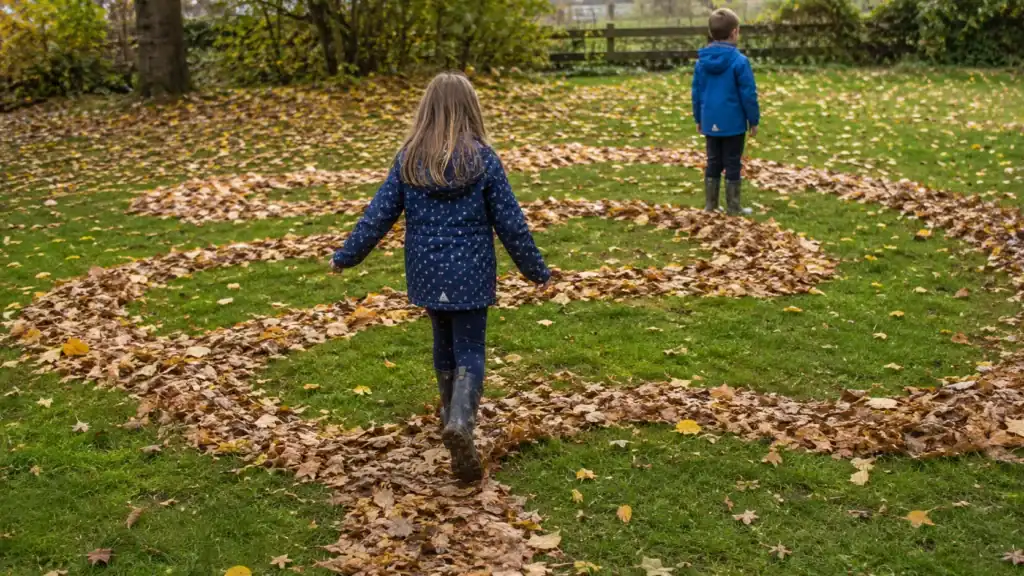
17. Build a leaf maze
Use loose leaves to mark a path across the grass.
Create:
- Turns
- Circles
- Zigzags
- Dead ends
- A finish line
Kids can walk, hop or tiptoe through the maze without stepping over the edges.
Need even more zero-cost ideas for outside? Try these 30 free backyard activities for kids using space and materials you probably already have.
18. Build a tiny leaf shelter
Use a few small sticks to make a miniature frame.
Layer fallen leaves over the top.
It could become:
- A fairy house
- A tiny animal shelter
- A forest hideout
- A miniature den
Keep it small and avoid clearing large areas of leaf litter.
That matters because fallen leaves are habitat. The Xerces Society notes that leaves provide shelter and insulation for butterflies, other insects and many invertebrates over winter.
19. Draw the missing half of a leaf
Choose a leaf with an interesting shape.
Trace it onto paper, then create a version showing only half the leaf.
Ask your child to draw the missing side.
It is a nice combination of nature observation and drawing without turning it into a formal worksheet.
For another creative variation, The Artful Parent has several drawing activities that use real or photocopied leaves as the starting point.
20. Start a family leaf tradition
Pick one activity everyone enjoyed and repeat it every autumn.
Maybe you:
- Take the same leaf walk every year
- Photograph your biggest leaf
- Make a yearly leaf collage
- Build a leaf rainbow
- Press one special leaf
- Jump in the first big leaf pile of the season
The easiest traditions are often the ones that survive.
Want to keep the season going? Our 40 fall bucket list ideas for kids gives you even more easy ways to enjoy autumn together.
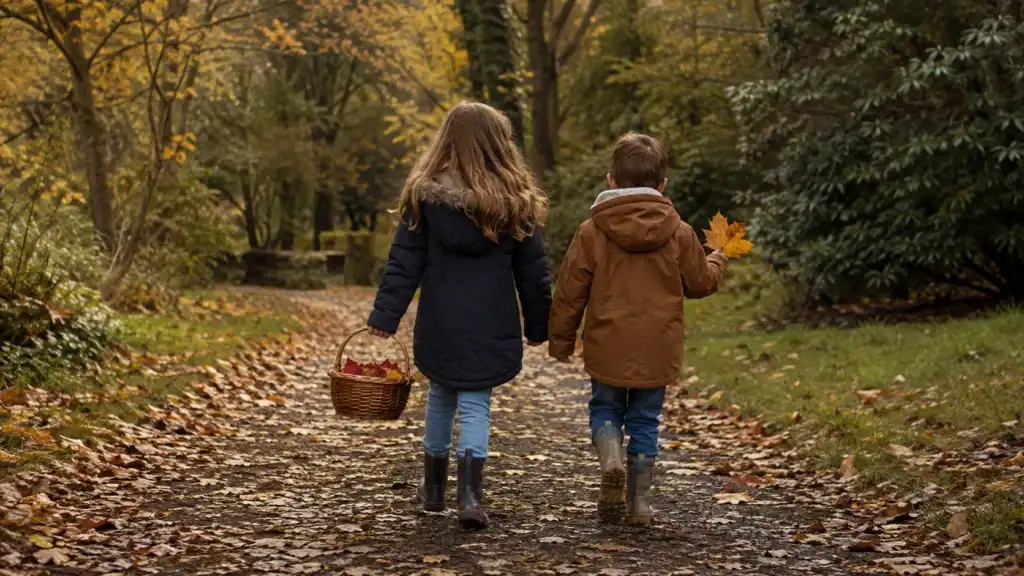
Sort leaves, crunch them, make a leaf face or find five different colors.
Try a leaf hunt, park walk, woodland trip or backyard leaf challenge.
Press a favorite leaf, make a print or turn one activity into a yearly tradition.
What can kids learn from playing with leaves?
Leaves are surprisingly useful learning materials because they naturally vary in color, size, shape, texture and structure.
Without turning the activity into a lesson, kids can practice:
Sorting and early math by grouping leaves.
Observation by comparing shapes and veins.
Fine motor skills through tracing, arranging and crafting.
Creative thinking by turning leaves into pictures and imaginary objects.
Science by noticing how trees and leaves change through the season.
Outdoor play itself also offers children opportunities for physical activity, exploration and curiosity.
A quick note about collecting fall leaves
Taking a handful of fallen leaves for an activity is very different from stripping living plants or removing every leaf from an area.
A simple rule is:
Take a few. Leave plenty.
Whenever possible:
- Use leaves that have already fallen.
- Avoid pulling healthy leaves from trees.
- Leave insects, eggs and cocoons where you find them.
- Follow local rules in parks and protected areas.
- Leave plenty of leaf litter undisturbed.
Leaf litter provides winter shelter and insulation for many invertebrates. If leaves need moving in a garden, Xerces suggests moving them into garden beds or lower-traffic areas rather than removing all of them.
GOOD TO KNOW
Frequently Asked Questions About Leaf Activities for Kids
Fall leaves are one of the easiest seasonal materials to turn into outdoor play, nature study and low-prep crafts.
What can kids do with fall leaves?
Kids can collect, sort, count, press, trace, paint, print, crunch and arrange fall leaves. They can also use them for collages, nature hunts, sensory play and simple science activities.
What are easy leaf activities for toddlers?
Simple toddler activities include collecting large leaves, sorting them by color, crunching dry leaves, filling a basket, making a basic collage and looking at leaves together outdoors. Supervise young children closely, especially around small natural objects.
Why do leaves change color in fall?
As autumn days become shorter, chlorophyll in deciduous leaves breaks down. Yellow and orange pigments become visible, while some trees also produce red pigments called anthocyanins.
Can you use fresh leaves for crafts?
Yes. Fresh leaves work well for printing, tracing and temporary collages. If you want a leaf to stay flat for longer, press it between sheets of paper inside a heavy book first.
Is it okay to collect fallen leaves?
Collecting a few fallen leaves is usually enough for children’s activities. Follow local rules in public or protected spaces and avoid removing large amounts of leaf litter, which provides habitat for insects and other small wildlife.
How do you preserve fall leaves for kids’ crafts?
One of the easiest methods is pressing. Place reasonably dry leaves between sheets of plain paper inside a heavy book and leave them for several days before using them for cards, collages or nature journals.
More Easy Ways to Get Outside This Fall
Keep going with more low-prep ideas built around leaves, rain, mud, nature and whatever the season gives you.
Leaves, mud, acorns, rain, sounds and simple sensory play outside.
RAINY DAY 25 Rain Activities for KidsPuddles, mud, worms, wet leaves and easy weather play.
ANY SEASON 17 Easy Nature ActivitiesEasy backyard, park and nature ideas you can start today.